Title: Rivers are part of the water cycle. Learn about river processes and landforms in this geography guide for students aged 11 to 14 from BBC Bitesize. - BBC Bitesize
URL Source: https://www.bbc.co.uk/bitesize/topics/zs92tfr/articles/z66mxbk
Markdown Content:
What do you know?
-----------------
### What is the longest river in the world?
[Back to top](https://www.bbc.co.uk/bitesize/topics/zs92tfr/articles/z66mxbk#main-content)
Key points
----------
* Rivers form part of the water cycle. They are a downward flow of water, under the force of gravity.
* Rivers shape the land through erosion, transportation and deposition. These processes create distinctive landforms.
* In the upper course, vertical erosion creates waterfalls and v-shaped valleys. In the middle course and lower courses, lateral erosion creates meander bends, oxbow lakes and deltas.
[Back to top](https://www.bbc.co.uk/bitesize/topics/zs92tfr/articles/z66mxbk#main-content)
What is a river?
----------------
### The water cycle
The hydrological cycle, or water cycle, shows the movement of water between the , land and oceans. Rivers form part of the hydrological cycle.
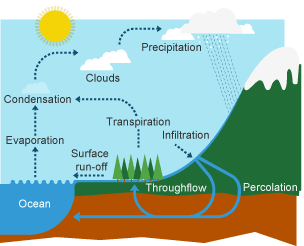
Figure caption,The water cycle is also known as the hydrological cycle. It is called a cycle because water moves continuously around the system.
* Energy from the Sun heats the surface of the Earth.
* Water is from oceans, rivers, lakes, etc.
* The warm, moist air rises because it is less dense.
* occurs when water vapour is turned back into water droplets as it cools down. Clouds are formed.
* occurs as water droplets get bigger and heavier they begin to fall as rain, snow and sleet, etc.
### The long profile
Rivers transport water downwards because of . As they move further downhill, they gather more water and become larger. Rivers can be divided into three sections: **the upper, middle and lower courses**. Together, these three courses form the .
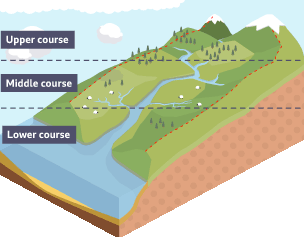
1. **Upper course** The start of the river at higher . The river channel is small. Vertical, or downwards, takes place here as water is pulled down by gravity.
2. **Middle course** The middle section of the river. have joined the channel and so the river is carrying more water.
3. **Lower course** The final stage of the river, usually where it meets the sea. The river is wide and deep because it is carrying a large volume of water. , or sideways, erosion and takes place here.
Question
--------
**Where does vertical erosion take place?**
[Back to top](https://www.bbc.co.uk/bitesize/topics/zs92tfr/articles/z66mxbk#main-content)
What are river processes?
-------------------------
Rivers shape the land by moving material from one place to another through **erosion**, **transportation** and **deposition**.
### Erosion
When material is removed from the riverbed and banks. There are four types of river erosion:
* **Attrition** rocks carried by the river collide. They break up into smaller, smoother pieces.
* **Abrasion** rocks carried by the river scrape along the bed and banks. This loosens material, which is then carried away by the water in the river.
* **Solution** particles are dissolved by the river.
* **Hydraulic action** - the force of the river against the banks. Air becomes compressed within cracks and crevices, which weakens the banks.
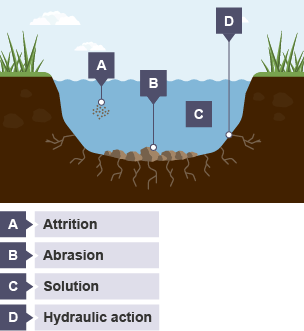
Figure caption,Types of river erosion
### Transportation
When material is moved further downstream. There are four types of transportation:
* **Suspension** smaller material that is light enough to be continuously carried along.
* **Traction** large rocks are rolled along the riverbed at times of high energy, eg when the river level is high.
* **Solution** very small material that is dissolved and can be transported even during times of low energy.
* **Saltation** the water picks up rocks and pebbles. They are too heavy to be carried far and so they appear to bounce along the riverbed.
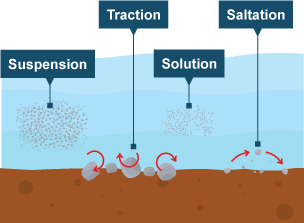
Figure caption,Types of river transportation
### Deposition
When material is dropped by the river.
Deposition happens when river energy is low, for example when the flow of the water slows down. It can happen along any part of the river, but is common in the lower course, where the river meets the sea. Larger, heavier material is deposited first. Smaller, lighter material can often be carried during times of low energy.
Question
--------
**What transportation process moves the largest rocks in a river?**
[Back to top](https://www.bbc.co.uk/bitesize/topics/zs92tfr/articles/z66mxbk#main-content)
What are river landforms?
-------------------------
Different landforms are located along the river long profile.
Image gallery[Skip image gallery](https://www.bbc.co.uk/bitesize/topics/zs92tfr/articles/z66mxbk#storyboard-end-of-image-gallery)
1. 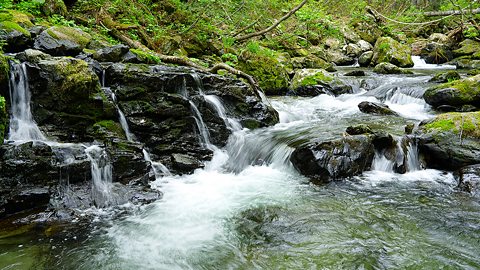
Image caption,
**Waterfalls and rapids**
Waterfalls and rapids are found in the upper course. These form when rivers flow over hard and soft rock. Vertical erosion wears away soft rock, forming rapids and waterfalls.
1 of 6
Slide 1 of 6, Waterfalls and rapids are found in the upper course., Waterfalls and rapids Waterfalls and rapids are found in the upper course. These form when rivers flow over hard and soft rock. Vertical erosion wears away soft rock, forming rapids and waterfalls.
Question
--------
**Name one landform found in the upper course of a river.**
[Back to top](https://www.bbc.co.uk/bitesize/topics/zs92tfr/articles/z66mxbk#main-content)
Test your knowledge
-------------------
[Back to top](https://www.bbc.co.uk/bitesize/topics/zs92tfr/articles/z66mxbk#main-content)
[Back to top](https://www.bbc.co.uk/bitesize/topics/zs92tfr/articles/z66mxbk#main-content)