🔬
Understanding Meiosis and Its Importance
May 31, 2025
What is Meiosis?
Meiosis is a biological process where a single cell divides twice to produce four cells with half the original amount of genetic information. It is crucial for the formation of sex cells (gametes) such as egg and sperm cells.
Key Concepts
- Definition: A single cell divides twice, producing four daughter cells (haploid).
- Purpose: Meiosis creates gametes necessary for sexual reproduction.
Stages of Meiosis
Meiosis can be divided into two main phases: Meiosis I and Meiosis II, with each phase containing several stages.
Meiosis I
-
Interphase
- DNA is copied, resulting in two identical sets of chromosomes.
- Two centrosomes with centrioles are present outside the nucleus, critical for cell division.
- Microtubules extend from the centrosomes.
-
Prophase I
- Chromosomes condense into X-shaped structures.
- Chromosomes pair up (homologous chromosomes).
- Recombination (crossing over) occurs between paired chromosomes.
- The nuclear membrane dissolves, and the meiotic spindle forms.
-
Metaphase I
- Chromosome pairs align along the cell's equator.
- Meiotic spindle fibers attach to one chromosome of each pair.
-
Anaphase I
- Chromosome pairs are pulled apart to opposite poles.
- Sister chromatids remain attached.
-
Telophase I and Cytokinesis
- Chromosomes gather at opposite poles, forming new nuclei.
- The cell divides into two daughter cells, each with a full set of chromosomes.
Meiosis II
-
Prophase II
- Each daughter cell contains 23 chromosomes (23 pairs of chromatids).
- Chromosomes condense again, and the nuclear membrane dissolves.
- Centrioles duplicate, and meiotic spindle forms.
-
Metaphase II
- Sister chromatids line up along the equator of each daughter cell.
- Meiotic spindle fibers attach to sister chromatids.
-
Anaphase II
- Sister chromatids are pulled to opposite poles, becoming individual chromosomes.
-
Telophase II and Cytokinesis
- Chromosomes gather at poles, forming new nuclei.
- Cytokinesis completes, resulting in four granddaughter cells, each haploid:
- For individuals with XY chromosomes: all four are sperm cells.
- For individuals with XX chromosomes: one is an egg cell, and three are polar bodies.
Conclusion
- Meiosis is essential for sexual reproduction and genetic diversity.
- Distinct from mitosis, meiosis involves two rounds of division and results in haploid cells.
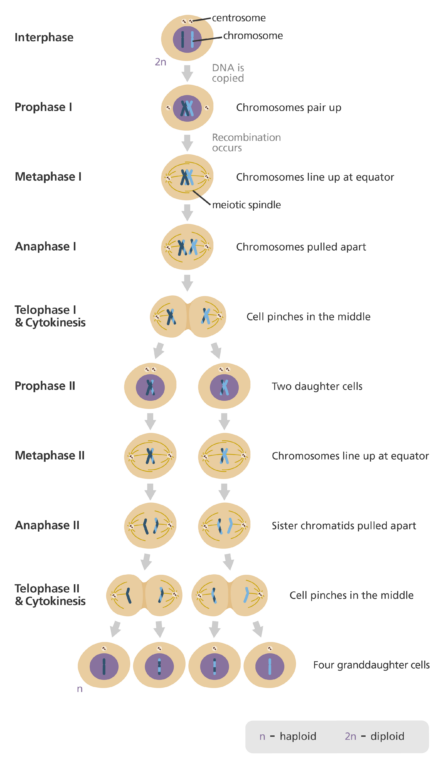
Image credit: Laura Olivares Bold / Wellcome Connecting Science
Further Reading
- Explore cell division and compare mitosis to meiosis.