🌡️
Understanding Specific Heat Capacity Concepts
Apr 30, 2025
Lecture Notes: Specific Heat Capacity
Learning Objectives
- Define heat capacity and specific heat capacity and differentiate between the two.
- Predict which substance will experience the greatest temperature change based on specific heat capacities.
- Calculate unknown variables using the specific heat equation.
Heat Capacity
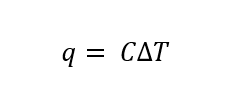
- Definition: Amount of heat needed to raise the temperature of a substance by 1°C.
- Equation:
- Concept:
- A small heat capacity leads to quick warming.
- A high heat capacity allows absorption of more heat with less temperature increase.
- Example: Metal pots (low heat capacity) vs. plastic handles (high heat capacity).
- Dependence:
- Depends on material identity and quantity.
- Greater mass substantiates greater heat.
- Consistent comparison requires constant substance quantity.
Specific Heat Capacity
- Definition: Heat required to change the temperature of 1g of a substance by 1°C.
- Equation: q = mcΔT
- Note: Capital “C” refers to heat capacity, lower case “c” to specific heat capacity.
- Specific heat capacity allows calculation of an object's heat capacity based on another object of the same material but different mass.
- Properties:
- Intensive property (does not depend on quantity).
- Heat capacity is extensive (depends on quantity).
- Phase Dependence:
- Different phases of the same substance can have different specific heat capacities.
Key Concepts
- Intensive vs. Extensive:
- Specific heat capacity is intensive, while heat capacity is extensive.
- Example Calculation:
- Exercise: Identifying which material will have the highest temperature upon heat absorption (solid gold).
Table: Specific Heats of Common Substances
- Helium (g): 5.193 J/g°C
- Water (l): 4.184 J/g°C
- Ethanol (l): 2.376 J/g°C
- Ice (s): 2.093 J/g°C
- Water Vapor (g): 1.864 J/g°C
- Nitrogen (g): 1.040 J/g°C
- Air (mixture): 1.007 J/g°C
- Oxygen (g): 0.918 J/g°C
- Aluminum (s): 0.897 J/g°C
- Carbon Dioxide (g): 0.853 J/g°C
- Argon (g): 0.522 J/g°C
- Iron (s): 0.449 J/g°C
- Copper (s): 0.385 J/g°C
- Lead (s): 0.130 J/g°C
- Gold (s): 0.129 J/g°C
- Silicon (s): 0.712 J/g°C
Examples
- Exercise 1: Solid gold will have the highest temperature increase when equal masses of water, gold, and iron are exposed to the same heat.
- Example 2: Calculation of final temperature of Aluminum when given heat and mass.
Additional Information
- The specific heat capacity is crucial to identifying materials and predicting behavior under thermal exposure.
Contributors
- Robert Belford (UA of Little Rock)
- Ronia Kattoum (UA of Little Rock)